
patent: https://pdmwatrwisepatent.wordpress.com
Check your water pressure! WatrWise™ water storage systems create a beneficial pressure differential that causes the pressure tank(s) to supply water initially, when you “demand” water by turning on the water in your house. This is how we prevent water stagnation in the pressure tank(s) by cycling stored water every time you use water.
Here are two links, Amazon or Home Depot, where you can buy a pressure test gauge, that is attached to a hose bib/faucet to measure household pressure. The type that you want to use has an extra (red) needle that has a reset dial or button in the center. This needle marks the highest pressure that has occured since you last reset it. Leave it attached and the faucet “on” overnight and check the reading every morning for a week. Reset the red needle by turning off the water and loosening the connection to relieve any pressure. Turn or press the center button to reset the red needle to zero. Tighten the connection and turn the water back on for the next test. Don’t forget to write down the readings that you are taking. The reason you want to take many readings over a week or so, is to see if there is higher pressure on a certain day of the week or on weekends (more or less people using water).
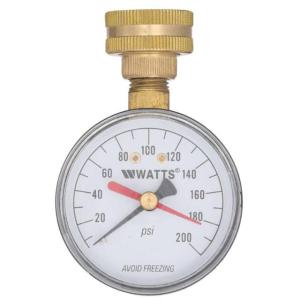
Static (no flow) water pressure in your home should not exceed 70 psi (lower is better, I know the movie above mentions 80 psi . . .). WatrWise™ operating water pressure is adjustable dependent on your specific situation. Ideally your WatrWise™ operating “range” is 30 to 60 psi (70 psi maximum). WatrWise™ is pressure rated to 100 psi; however, this is an opportunity to run your household at a more friendly pressure than you have in the past, if your investigations show that you have high pressure.

High water pressure, higher than 60 psi, is unnecessary. High water pressure stresses all of your pipes, fixtures and appliances in and around your home, including the pool fill and irrigation systems. High pressure also causes higher flow rates wasting water (conservation), raising your water bill.

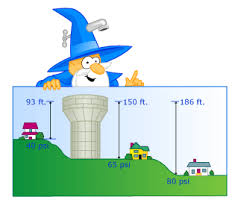
Water systems use pressure to move water throughout the system. Elevation effects pressure and there is friction losses (pressure loss) resulting in pressure differences at varying places served by the water system. Simply put, piped water is affected by elevation.
 Reserved Water Storage
You must be logged in to post a comment.