

Emergency Demand Water Sharing
WatrWise™ SRRS intent is only to help cover the differential between supply and emergency demand.
For example, demand is 500 GPM and supply is 475 GPM and pressure falls more than 5 psi… then WatrWise™ SRRS will deliver water to help stabilize falling pressure/flow. In this case 25 GPM. 25 GPM divided by 150 tanks equals .167 GPM per tank average.
Tanks closer to the water user; in this case fire fighters fighting a fire using fire hydrants, will deliver water until their pressure matches the supply pressure (plus 5 psi)and so on down the supply line.
This balances the delivery of water across the tanks serving the system.
Remember that the check valves closed and isolated each tank and water user the moment pressure started falling, while continuing to supply water to the water user. Effectively isolating all the water users in the area while continuing to supply their water needs, under pressure. Only if pressure continues to fall – more than 5 psi differential – will the tanks start delivering water to the supply line! Isolating water users in the area (while supplying their water needs) allows more water to be available for emergency demand because the tanks would be supplying water users rather than the mainline.
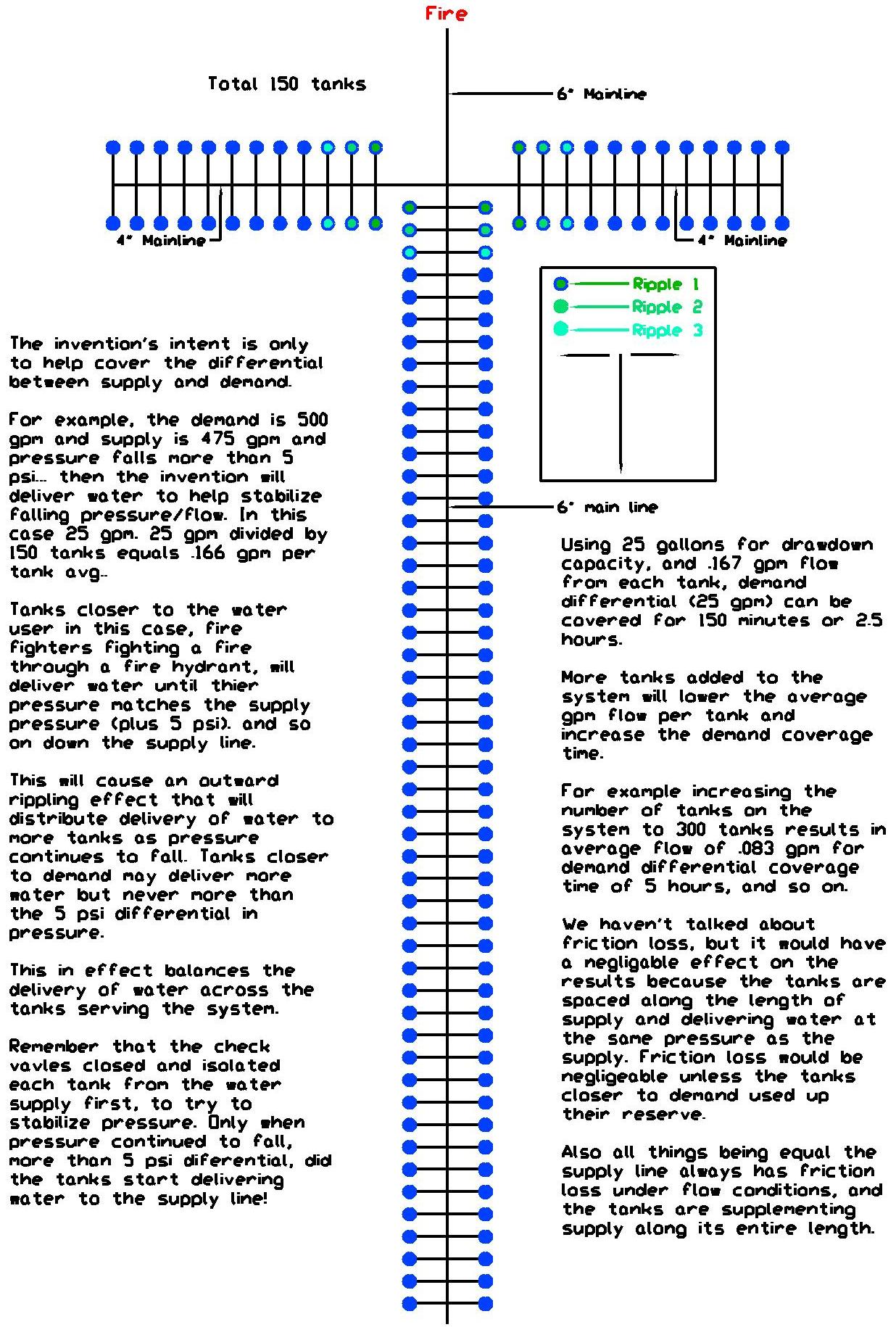 This will cause an outward rippling effect that will distribute delivery of water to more tanks as pressure continues to fall. Tanks closer to demand may deliver more water but never more than the 5 psi differential in pressure.
If for some reason pressure in the mainline continues to fall – more than 5 psi differential – the tanks would supply water to the mainline.
Using 25 gallons for drawdown capacity, and .167 GPM flow from each tank, demand differential (25 GPM) can be covered for 150 minutes or 2.5 hours.
More tanks added to the system will lower the average GPM flow per tank and increase the demand coverage time. For example, increasing the number of tanks on the system to 300 tanks results in average flow of .083 GPM for demand differential coverage time of 5 hours, and so on.
We haven’t talked about friction loss; but it would have a negligible effect on the results because the tanks are spaced along the length of supply and delivering water at the same pressure as the supply. Friction loss would be negligible unless the tanks closer to demand used up their reserve.
Also all things being equal the supply line always has friction loss under flow conditions, and the tanks are supplementing supply along its entire length.
WatrWise™ EWS does not return water to Water Supply. WatrWise™ EWS isolates water users while reserving water for use during low pressure caused by peak demand and water service or supply interruptions. Commonly called emergency water storage.
WatrWise™ is committed to designing water storage systems that impact people everywhere.
 Reserved Water Storage
I’ve been exploring for a little bit for any high-quality articles or weblog posts in this kind of house . Exploring in Yahoo I finally stumbled upon this web site. Studying this information So i am happy to convey that I have an incredibly good uncanny feeling I discovered just what I needed. I so much for sure will make sure to don’t overlook this web site and give it a glance regularly.
LikeLike